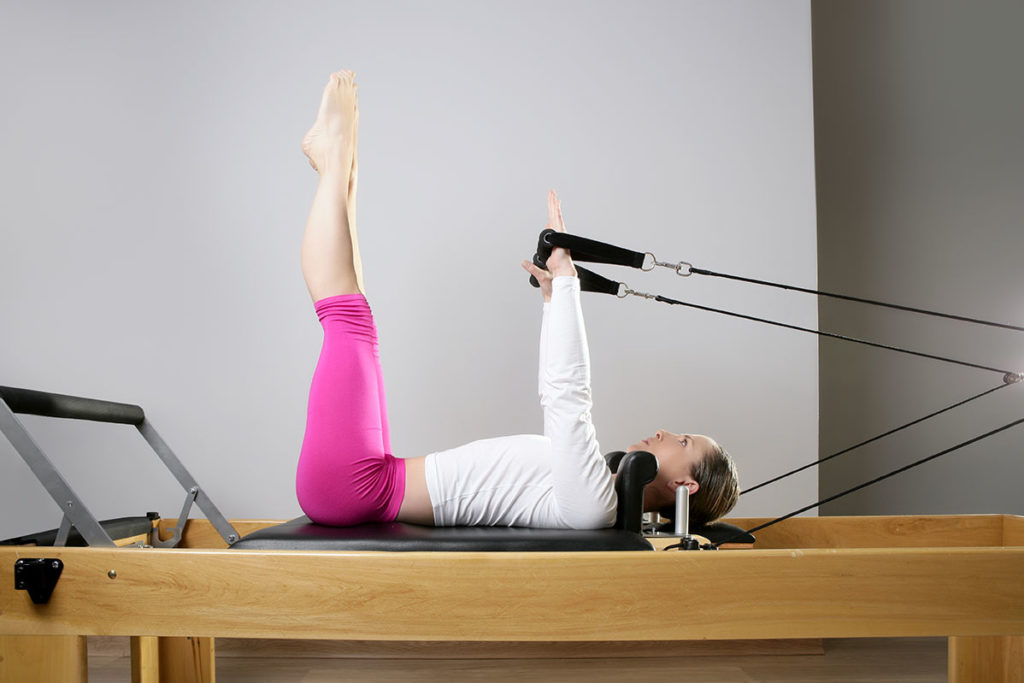
If you’re JUST looking to lose weight - Pilates is NOT the most efficient method. Pilates is a unique form of exercise that has many benefits. These benefits are most efficiently achieved by practicing pilates. Weight loss is not one of these “most efficient” benefits. Pilates is unique in that it changes your body shape without necessarily affecting your weight significantly.
When I first implemented a pilates regimen into my weekly workout routine it was to tone and strengthen my body. I had a couple of spots that I wanted to look more... firm. Because I didn’t have any time to add in more aerobic activity, the only change I made was to add pilates.
I noticed, after about a month, that my clothes started to fit differently. My pants were a little looser in the waistband and thigh area and my arms were more toned. I was a little mystified to see that my weight on the scale remained the same. When I would see my family and friends our greeting was quickly followed by “Have you lost weight?” Though I could only feel a slight difference that my at-home pilates regimen was making, others could tell a large difference. When I informed people that the only change I made was the addition of pilates (not any more exercise or diet) they continued to comment on how long and lean I looked. Though I originally tried pilates for an alternate reason than losing weight I didn’t mind the flattering comments!
Is Pilates Really a Weight Loss Program?
You’ve heard the claims of many - like Winsor pilates - that pilates is your magic pill for weight loss! So is pilates really everything that it is made out to be? Can I feel like a celebrity for only an hour a day AND lose 65 pounds while obtaining a rock hard bum?!
Let’s break this down.
How To Lose Weight
Simple. You need to burn more calories than you consume. A six month long study published in the Journal of Clinical Endocrinology and Metabolism (Redman, et.al., Effects of Calorie Restriction..., 1/2007) confirmed that weight loss is based on calories. Your caloric intake needs to be less than your calories exerted. It IS possible to consume less calories than you are exerting WITHOUT exercise, but it gets pretty difficult - especially with the availability of fast food and trendy high sugar coffee drinks - and can also be unsafe. Exercising has a whole slew of other added benefits that you want to reap as well!
Why Exercise?
Exercise is divided into two different groups: aerobic and anaerobic exercise.
Aerobic exercise is moderate exercise performed for a long duration of time. Anaerobic exercise is used to build power and/or muscle mass. These muscles generally have a greater performance under a short duration/high intensity situation. Aerobic and Anaerobic exercise has numerous benefits, besides helping maximize the caloric output to increase weight loss or weight maintenance.
- Strengthens the respiratory muscles
- Strengthens the heart muscles
- Tones muscles in the body
- Improves overall circulation
- Reduces Blood Pressure
- Boosts immune system
- Boosts Mood, and more!
Some say aerobic exercise is better (for weight loss) than anaerobic and vice versa - but the key is to make your caloric intake less than you caloric output. How you achieve that is solely up to you.
The Mayo Clinic conducted a study using several hundred people, weighing around 145 pounds, to find the calories burned during one hour of various forms of exercise. The results were as follows: (8/19/08 The Mayo Clinic seems to have updated their study and no longer use a 145 pound person, if you are checking the study.)
- Aerobic Dancing 416
- Backpacking 448
- Badminton 288
- Bicycling (outdoor) 512
- Bicycling (stationary) 448
- Bowling 192
- Canoeing 224
- Dancing 288
- Gardening 256
- Golfing 288
- Hiking 384
- Jogging (5 mph) 512
- Racquetball 448
- Rope Jumping 640
- Running (8 mph) 864
- Skating 448
- Skiing (cross-country) 512
- Skiing (downhill) 384
- Stair Climbing 576
- Swimming 384
- Tennis 448
- Volleyball 192
- Walking (2 mph) 160
- Walking (3.5 mph) 243
On SELF.com, which I found to be the most thorough source, I found the following information for a 145 lb person doing pilates for one hour:
- Beginner level pilates 241 calories
- Intermediate level pilates 338
- Advanced level pilates 421
If I plugged in someone who weighed less than 170 lbs, the amount of calories burned was less.
Pilates and Exercise: The Answer
Someone doing a regular form of exercise like jogging (512 calories burned) would still need to watch what they eat because a Big Mac with cheese is 740 calories! This is a similar situation in
pilates. When pilates is compared to the general exercise list - the calories burned is in between both extremes. It IS possible to lose weight while using pilates as a source of exercise - but you have to watch how many calories you ingest. To put it bluntly - if you are only doing an hour of
pilates exercise each day (and no other exercise) and you wanted to lose weight, you would really need to count your calories. Remember the formula - calories exerted needs to be greater that calories ingested, for weight loss. Not many people eat less than 338 calories a day, which is the amount of calories you will burn in an intermediate level mat workout. Personally, if I were ONLY looking to lose weight I would not recommend pilates because it is simply not the most efficient way to lose weight. In a day and age where time somehow equals money - efficiency (and effectiveness) is key.
Pilates Results
I don’t get many clients who seek me out as a pilates instructor and say “I want to lose weight” but I do get athletes who come to me and say “I want to excel in my sport,” as well as executives and college students! I love having clients of many different shapes and sizes who come to the pilates studio for a myriad of different reasons OTHER than weight loss. People who have purely weight loss goals often leave the studio more frustrated over time because they are not dropping the weight they want to lose. Many different body types come into the pilates studio for motives of which I would recommend pilates as the number one source for efficiency and effectiveness. Here are a few:
- Improved posture
- Full body tone
- Relieved back pain
- Increased joint mobility and control Increased flexibility
- Improved sports performance
- Off season conditioning, and more!
Pilates and Extraordinary Effects on the Body
Pilates does change the shape of your body - clothes fit differently
Pilates tightens your waistline even if no weight is lost on the scale
Pilates builds muscle without bulk and improves posture - makes you seem taller and slimmer
Pilates tones all of your muscles because each exercise is a full body workout - makes your body something to brag about. Paired with the right program, pilates will help those pounds drop off!
Misrepresentation in Pilates Marketing
1- So why do some pilates ads demonstrate a 300+ lb. person shown as losing 150 lbs. via pilates?
It should be noted that someone who is larger/has had little activity for an extended amount of time will lose more weight than a fit person. For instance, someone who hasn’t exercised in a couple of years will lose more weight from pilates (or any other amount of moderate activity) than the recreational cyclist.
2- Certain pilates programs can be modified to help boost weight loss but this does not mean that all pilates workouts are going to help you lose weight.
The type and level of workout you participate in can really make a difference in how many calories you burn. Pilates classes and privates are taught very differently all over the world. Some classes are slower and based more on principles, some are moderate, and some are geared towards weight loss by doing rapid fire workouts with added pilates props like the jump board on the reformer. It has been noted that doing a cardio form of exercise prior to a pilates workout helps the heart rate stay high during the pilates workout. Minimizing the breaks between exercises also helps to keep the heart rate high.
Optimal Pilates Weight Loss Program
- Decide your goals or motives for doing pilates and discuss them with your instructor
- Decide your weight loss goals
- Keep a log of your daily calories consumed and your daily calories exerted in exercise - calories exerted needs to be bigger than calories ingested to achieve weight loss
- Boost your calories exerted with pilates and your favorite other form of exercise
So pilates really does sculpt the body - giving an optical illusion that you have lost weight. It is possible to incorporate pilates into a weight loss regime and successfully lose weight, but you have to keep in mind the other things you have to do to achieve weight loss. The idea that pilates is the new Ephedra is bad marketing from the pilates industry which frustrates pilates instructors possibly more than their clients! Everyone can gain an advantage from practicing pilates because it has a vast number of benefits - just don’t confuse weight loss with its unique list of benefits.
Keep in mind that this article focuses on the controversy around pilates and weight loss. While Pilates does have some excellent effects on the body relating to weight and appearance, these are not the main bragging rights of pilates.
As I am trying to come up with a series of exercises for an upcoming "Mommy and Me" Pilates class I am starting, I was going through some of my older books that I haven’t read through in a while and I came across the "Nine Commandments of Pilates". I thought it was clever, being Easter is in just a few days.
First Commandment: WORK FROM YOUR POWERHOUSE!
This means that you are working your body from the middle not from your arms and your legs. How to do this? Observe your body... Is my lower back arching? Are my ribs sticking out? Are my shoulders up by my ears? If the answer to any of these questions is "Yes" you are not working from your powerhouse and are putting yourself at risk for injury.
Second Commandment: Engage Your C Curve!
In your C- Curve, your navel is pulled back toward your spine and your tailbone and pelvis are curled under. Think of creating the letter C with your body, starting at your tailbone through your crown, then hollow or "Scoop" the front of your torso. If you feel you are pulling your stomach away form your waistband you are doing it correctly.
Third Commandment: Assume The Pilates Stance
The "Pilates Stance" is simply heels together toes apart. Not turning our from your ankles or knees, but naturally rotating the entire leg outward from the hip rotators to deepen the engagement the pelvic floor. Wrapping up through your inner thighs as if standing like a Greek column. The toes should be a hands width apart, no further.
Fourth Commandment: Articulate Your Spine!
Articulating your spine is to roll up and down one vertebra at a time. Rolling fluidly and melting each vertebra individually onto the mat develops flexibility and elongation in the spine. The Roll-Up and Teaser are prefect examples of movements that require you to roll up and down one vertebra at a time allowing you to release tension and elongate the spine while strengthening your powerhouse.
Fifth Commandment: Work Within Your Frame
Joseph Pilates could not emphasize alignment enough! When you move in proper alignment, you are working within the frame of your body, that is, within the width of your shoulders and hips. Precise movements within your own body frame protect your joints from injury and promote healing. To ensure proper alignment is being preformed, an exercise should not be repeated more than 10 times. Maintaining proper alignment requires effort and concentration that Mr. Pilates believed it could not be sustained through high repetitions. "It's better to do it perfect 10 times than 50 times in poor form."
Sixth Commandment: Chin To Chest
This is a very common instruction in many pilates exercises. It means to lift your head forward off of the mat so that the back of your entire neck stretches and reaches down into the chest area. Your eyes should be locked on your belly button. This is encouraged to create the energy exerted to come from the powerhouse and create more space from your shoulders to your ears. If you are holding your neck incorrectly it can create much tension and cause the lower back to arch.
Seventh Commandment: Don't Be a Mouth Breather
Again as quoted by Joseph Pilates, "You eat with your mouth and you breath with your nose." Breathing in pilates is very important and to ensure that you are getting full quality breath, your mouth stays out of the whole affair. Breathing through your nose enables you to fill your lungs to capacity and take in much more oxygen. Breath is coordinated with your movement, inhaling as you reach or extend to pull oxygen into the elongating muscles. Exhale as your contract or bend inward fully emptying out stale air. Proper breathing will discourage muscle tension and encourage concentration and calm execution.
Eighth Commandment: Move with Intention
Maintain the integrity of your alignment! Each exercise should be preformed in a careful and focused manner. No need to go thrashing around. Since you limit the repetitions to 10 or less, make it worth your while by concentrating and moving slowly and deliberately. Do not rush through your exercises.
Ninth Commandment: No Powerhouse Was Built in a Day
Start slowly, you don't need to tackle every exercise in one day. Pilates is based on the principle of progression, that is slowly adding exercises to your workout so that you build up to longer more advanced workouts. One never really advances from the basic exercises, you just add in more exercises to make it more challenging. Work hard and work daily and you will be able to get up to a full body workout that delivers results!